ELMFIRE - Eulerian Level set Model of FIRE spread
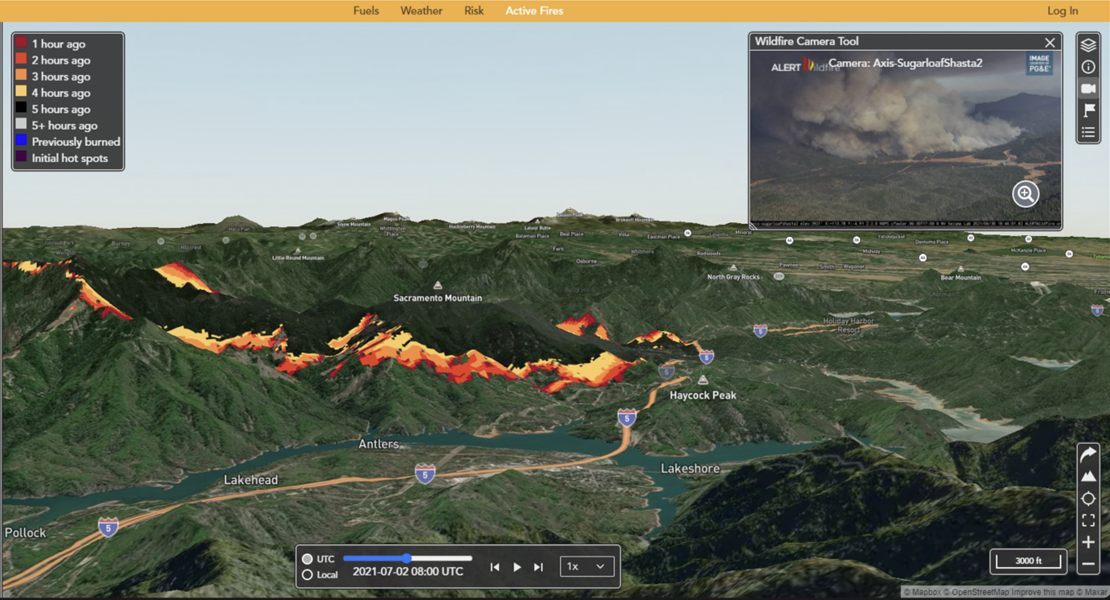
ELMFIRE is an operational wildland fire spread model used by fire agencies, researchers, and engineers to model how wildfires grow across real landscapes. It couples the Rothermel and CFFDRS surface spread formulations with a level-set front-tracking method, and runs efficiently in parallel from a laptop up to a large compute cluster.
As part of the Pyrecast project, ELMFIRE forecasts the spread of most large fires in the Continental US.
This site is the ELMFIRE User Guide. It covers configuration and day-to-day use, the mathematical formulation behind the model, the full input parameter reference, and the verification and validation cases the model is tested against.
Download the full guide (PDF)What ELMFIRE can do
Real-time forecasting - predict where an active fire will spread.
Historical reconstruction - reconstruct the spread of past fires.
Fire behavior potential - quantify landscape-scale spread, fireline intensity, flame length, and crown fire potential.
Risk assessment - estimate annual burn probability and fire severity through Monte Carlo simulation.
Spotting, smoke, and WUI - model ember transport, smoke emissions for HYSPLIT, and structure-to-structure spread in the wildland-urban interface.
Suppression - represent the effect of initial and extended attack on fire growth and containment.
ELMFIRE ingests standard gridded inputs - fuels, topography, weather, and moisture as GeoTIFFs - and produces georeferenced raster outputs such as time of arrival, fireline intensity, spread rate, and flame length.
Getting started
ELMFIRE runs on Linux; Windows users can run it under WSL2. In outline:
Install the build prerequisites (compiler, MPI, GDAL, Python tooling).
Clone the repository.
Set
ELMFIRE_BASE_DIRand the related environment variables.Build the executables with
build/linux/make_gnu.sh.
The Installation section has the full procedure with exact package lists and environment variables, and is the authoritative reference - follow it rather than the outline above. A Docker image is also available if you prefer a self-contained environment.
The fastest way to learn ELMFIRE is to run it. Work through the tutorials, which progress from an idealized constant-wind case to full simulations with real fuels and weather, then confirm your build against the verification cases.
How a run is configured
A simulation is driven by a single plain-text input file built from Fortran
namelists - &INPUTS, &SIMULATOR, &OUTPUTS, &MONTE_CARLO,
&WUI, and others. Each namelist groups related settings: input rasters, run
control, requested outputs, Monte Carlo perturbations, and so on. Every
parameter ELMFIRE accepts is listed in the
Input Parameter Reference, grouped by namelist and
linked to the section of the guide that explains it.
Documentation
Contents
- Computational Guide
- Introduction
- Surface Fire Spread
- Computational domain size, extents, and resolution
- Time
- Fire Initialization
- Outputs
- Miscellaneous
- Parallelisation and MPI
- Physics and Numerics options
- Barriers and Breaching
- Spotting
- Monte Carlo Analysis
- Urban Fire Spread
- Suppression
- Fire Potential Mode
- Assets at Risk
- Pyrome Calibration
- Smoke
- Memory Optimization
- Docker and Containerisation
- Data Sources and Helper Scripts
- Process Flowchart
- Mathematical Background
- Verification
- Validation
- Input Parameter Reference
Reference
The complete guide is also available as a single PDF, rebuilt from the same sources as this site, so the two never disagree.
Background and citation
The mathematical formulation of ELMFIRE is described in its original journal article. If you use ELMFIRE in published work, please cite:
Lautenberger, C. (2013). Wildland fire modeling with an Eulerian level set method and automated calibration. Fire Safety Journal, 62, 289-298.
The Mathematical Background chapter documents the formulation as implemented, including the spread rate derivation, elliptical propagation, crown fire, and the spotting submodels.
License
ELMFIRE is released by CloudFire, Inc. under the GNU Affero General Public License v3.0 with the Commons Clause, which withholds the right to sell the software.
Academic research, personal projects, government agencies fulfilling public mandates, and nonprofit organizations acting for their stated nonprofit purposes may use ELMFIRE under those terms. Commercial use requires a separate commercial license.
See LICENSE.md and COMMERCIAL_LICENSE.md for the governing terms; the summary above is not a substitute for them.
Support
Questions, bug reports, and feature requests are welcome as GitHub issues. You can also contact Chris Lautenberger at chris@cloudfire.com.